







The United States, Germany and Russia all have their own way of throwing enemy missiles off target — and a short clip lines up the three approaches side by side.
“The US, Germany and Russia all have their own way of throwing enemy missiles off target,” the narration opens. What follows is a tour of three shipboard countermeasure systems, each built on the same idea: do not shoot the missile down — fool it.
The US answer: SRBOC
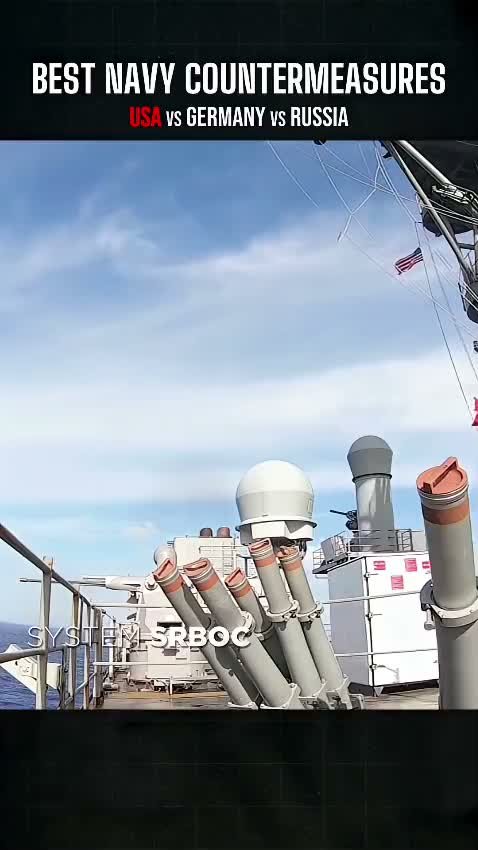
The American section shows the SRBOC system — the Super Rapid Bloom Offboard Countermeasures — the US Navy’s standard shipboard decoy launcher. Banks of launcher tubes sit on the deck, and the system fires mortar-launched cartridges that burst into a cloud of chaff: thousands of tiny radar-reflecting strips that bloom into a false target, drawing a radar-guided missile away from the ship.
The German answer: MASS
Germany’s system is the MASS — the Multi Ammunition Softkill System, built by Rheinmetall. Its trainable launchers fire 81mm Omni-Trap decoy rounds that work across the spectrum: radar, infrared, laser and ultraviolet. The system is fully automatic and is fitted to German Navy ships including Brandenburg-class frigates and Braunschweig-class corvettes, as well as to more than a dozen other navies worldwide.
The Russian answer: PK-2
The Russian section shows the PK-2, a shipboard decoy system that launches rocket-propelled decoy rounds. The clip shows the launchers on deck — marked with the red star — and the rockets firing out over the water, bursting into a decoy cloud behind the ship.
Softkill, not hardkill
All three systems are “softkill” defences. Unlike a missile interceptor or a close-in weapon system, they never touch the incoming weapon. They work by giving its seeker something else to chase: a brighter radar echo, a hotter infrared signature, a more tempting target than the ship itself.
The clip does not declare a winner, and neither should the comparison. Each navy built its system around its own ships, its own threats and its own doctrine. What they share is the principle — when a missile is already in the air, the cheapest way to survive it is to make it miss.
Sources: Video posted to ARQ Military; Rheinmetall (MASS); Wikipedia (Multi Ammunition Softkill System).