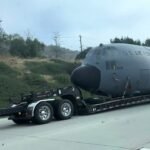








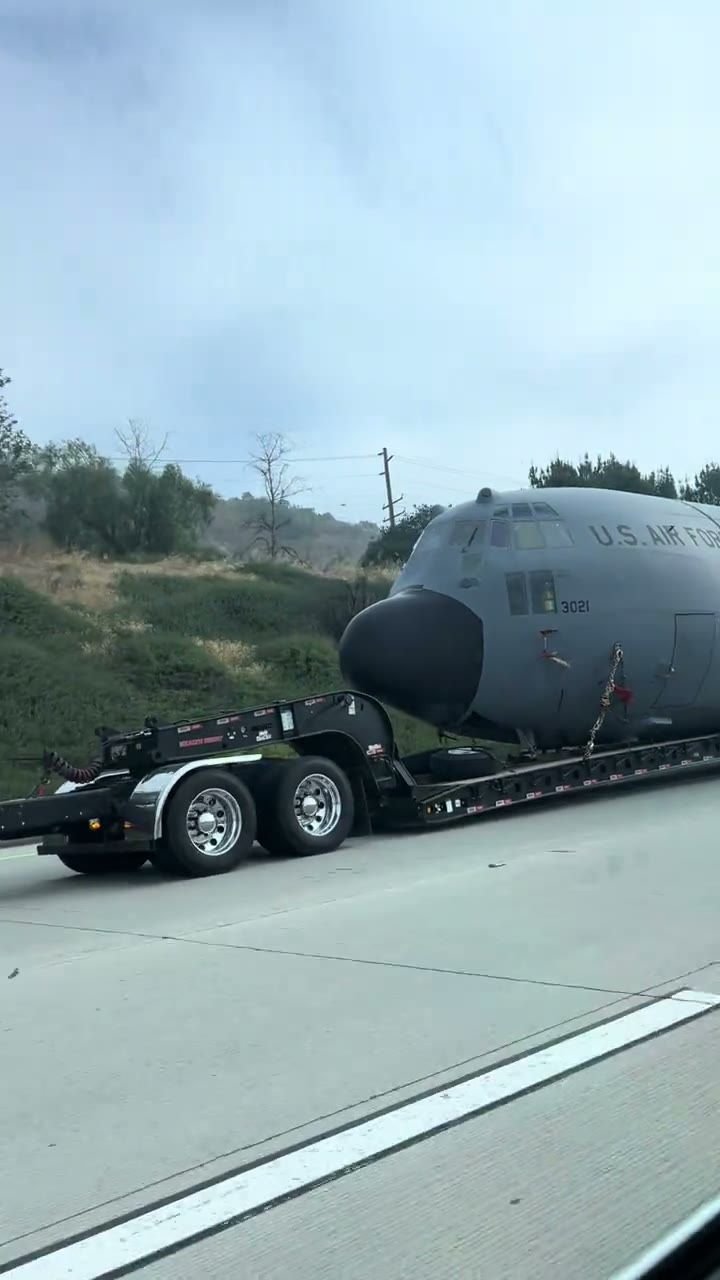
Drivers on the highway did a double take: a grey U.S. Air Force fuselage, “U.S. AIR FORCE” and the number 3021 stencilled on its side, riding down the road on a multi-axle lowboy trailer behind an “OVERSIZE LOAD” sign. No wings, no engines, no tail. Just the long tube of a C-130 Hercules, the U.S. military’s workhorse transport, being hauled like freight.
The plane in the clip
Aviation watchers who shared the footage identified the airframe as a retired C-130H Hercules, tail number 92-3021, being moved for ground training. The identification comes from the transport’s markings and from viewers who tracked the same fuselage through earlier sightings. The grey paint, the “3021” on the nose, and the missing wings and engines are all consistent with a retired airframe on its way to a second life on the ground.
Why a plane goes by truck
A retired C-130 cannot fly to its next home. Once the wings and engines come off, for maintenance training, a museum, or a parts donor, the fuselage becomes an oversize load like any other: strapped to a lowboy trailer, moved under state permits, with escort vehicles and a route planned around bridge clearances and intersections. It is the same treatment every retired military airframe gets when it cannot be flown out. In one earlier case, a C-130 fuselage bound for Tennessee as a future Airbnb got briefly stuck turning through a Maryland intersection, and the driver had to inch through the turn while troopers watched.
Seventy years of Hercules
The C-130 is the longest continuously produced military aircraft in history. The prototype first flew on August 23, 1954. The aircraft entered service in December 1956, and more than 2,500 have been built, 2,700-plus as of June 2024, with production still running in Marietta, Georgia. The four-engine turboprop has served as a cargo hauler, paratrooper platform, gunship, firefighter, hurricane hunter and Antarctic supply plane, and is flown by around 70 nations. The version on the truck, the C-130H, is the model that carried the type through the second half of the Cold War and into Iraq and Afghanistan. When one finally retires, it does not go quietly. It goes down the highway, on a trailer, with everyone staring.
What happens next
Retired Hercules fuselages end up in museums, as ground trainers for maintainers, as parts donors keeping other C-130s flying, or, in the Tennessee case, as an Airbnb. The one in the clip is headed for training duty, according to the viewers who identified it: a classroom with its wings removed, teaching the next generation of maintainers on an airframe that has been in continuous service for nearly seventy years.
Sources: Wikipedia, “Lockheed C-130 Hercules”; Instagram and Facebook posts identifying tail 92-3021; CDLLife, June 2025 (Maryland transport).