








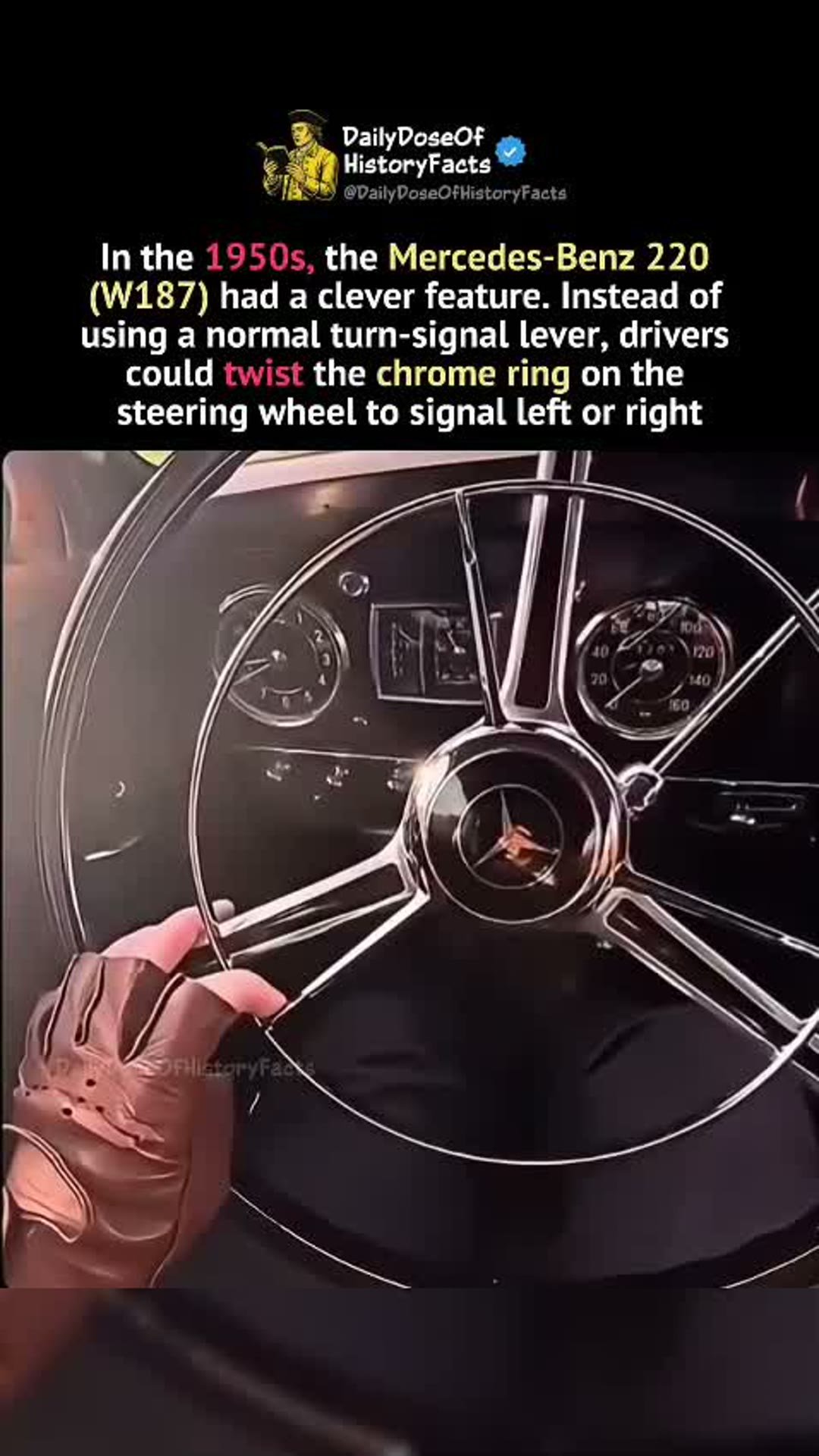
In the 1950s, the Mercedes-Benz 220 (W187) had a clever feature. Instead of using a normal turn-signal lever, drivers could twist the chrome ring on the steering wheel to signal left or right.
The clip shows it in action: a gloved hand grips the big chrome ring that circles the centre of the steering wheel and turns it, and the indicators click on. No stalk, no lever on the column — the whole ring is the switch.
The ring
The ring was the horn ring and the indicator control in one. Press it and the horn sounded; twist it left or right and the turn signals came on. It was a neat piece of packaging for a car built when dashboards were still working out what went where.
The arrangement made a certain sense. Your hands were already on the wheel, so the control was exactly where your fingers were. The owner’s handbook for the related Mercedes 180 of the same era put it plainly: to set the turning indicator, one had to turn the “contact ring” in the centre of the steering wheel.
The car
The W187 was a luxury car produced by Mercedes-Benz as a saloon, coupé and cabriolet from 1951 to 1955. Designated the 220, it was powered by a single overhead camshaft inline six-cylinder M180 engine, and it was introduced at the Frankfurt Motor Show in April 1951.
It was one of Mercedes’ elegant postwar models — a bridge between the pre-war cars the company had built before and the modern saloons that followed. The 220 took the older 170 S body and gave it a modern six-cylinder engine, reviving the design for a few more years.
Why it vanished
Column-mounted indicator stalks eventually became the standard everywhere, and the twist ring went the way of trafficators and hand signals. But for a few years in the early 1950s, signalling a turn in a Mercedes meant giving the steering wheel itself a twist — a small, tactile reminder of a time when car controls were still being invented.
Sources: Mercedes-Benz W187 (Wikipedia); 1953 Mercedes 180 owner’s handbook.