







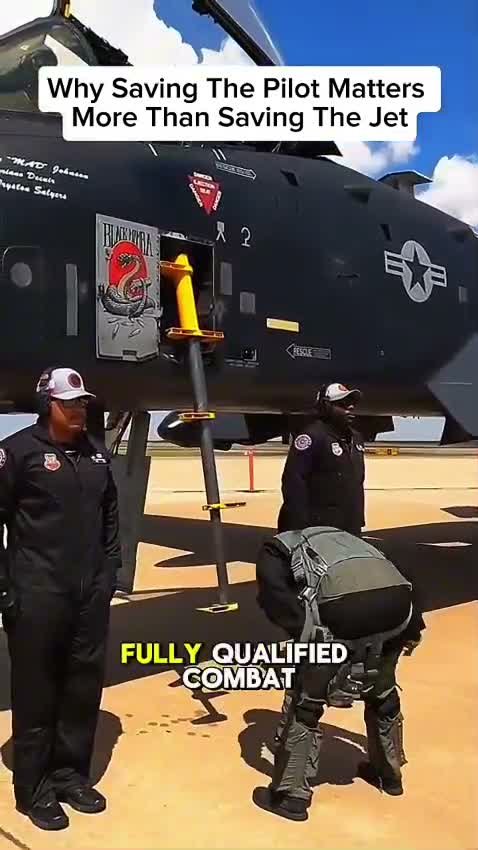
When a fighter jet goes down behind enemy lines, the response is immediate and often enormous: helicopters, escort fighters, special forces and dedicated rescue teams all moving toward one person. It can look reckless — risking many lives and expensive aircraft to save one. But air forces see the calculation very differently, because the pilot is not just a person in danger. The pilot is the hardest part of the whole air force to replace.
Training a fighter pilot costs millions
Turning a civilian into a combat-ready fighter pilot takes years and a fortune. In the United States, a trainee goes through roughly a year of undergraduate pilot training, then fighter fundamentals, then formal training on their specific aircraft, then mission training before they are combat-ready — typically two to three years in total, and longer to become truly experienced. A 2019 RAND Corporation study put the cost of training a basic qualified fighter pilot at $5.6 million for an F-16 pilot and $10.9 million for an F-22 pilot, in 2018 dollars. In Britain, the Ministry of Defence has said the average cost of training one fast-jet pilot is about £6.1 million. The jet itself, however expensive, rolls off a production line. The pilot takes years to build.
The pilot carries secrets a jet does not
There is a second reason rescue is urgent, and it has nothing to do with money. A captured pilot carries classified knowledge in their head: aircraft limits, routes, communications procedures, tactical signals and identification systems. That is why rescue is also an intelligence mission. An air force that lets a pilot fall into enemy hands risks handing over knowledge that could put every other pilot at greater risk. Getting them back protects the force as a whole, not just the one person.
Rescue is a mission of its own
Modern air forces treat rescue as a dedicated mission, not an afterthought. The US Air Force has pararescue specialists — known as PJs — whose entire job is to reach downed aircrew in hostile territory, treat them and bring them home. Rescue helicopters fly with fighter escorts and electronic warfare support, and the mission is rehearsed constantly, because the first hours after an ejection are usually the ones that decide whether a pilot comes home or becomes a prisoner.
The promise matters to every pilot who flies
There is also a human reason, and every pilot understands it. Flying combat missions means accepting that you might be shot down. Knowing that your country will move heaven and earth to bring you back changes how you fly — it gives pilots the confidence to take the risks their mission demands. A force that abandons its pilots does not just lose one person. It loses the trust of every pilot still in the air.
The bottom line
A jet is metal, software and fuel. It can be rebuilt, and its replacement can be flown by the next pilot in line. A combat pilot is years of training, millions of dollars and knowledge that cannot be downloaded or rebuilt. That is why the rescue goes in — not because the pilot’s life is worth more than anyone else’s, but because losing a pilot costs an air force far more than losing an aircraft ever will.
Sources: RAND Corporation 2019 study on pilot training costs, as reported by Simple Flying (Feb 2026); UK Ministry of Defence fast-jet training costs reported by UK Defence Journal and Defence UA.