








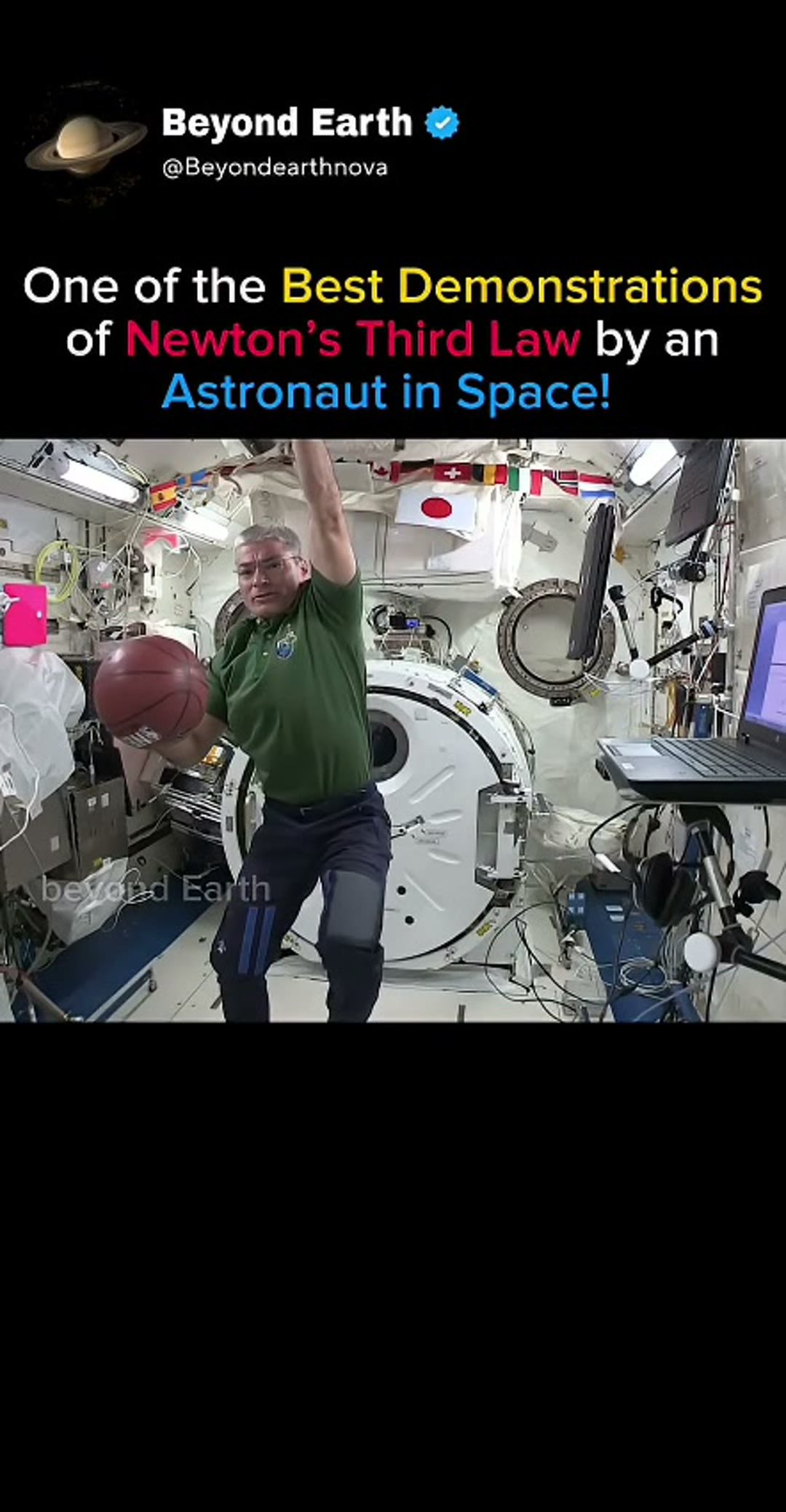
Floating inside the International Space Station, NASA astronaut Mark Vande Hei holds up a red basketball and sets up the simplest physics lesson ever filmed: Newton’s third law of motion, demonstrated in the one place on Earth — or off it — where nothing gets in the way.
The ball, he explains, is object one. He is object two. If object two applies a force to object one, then object one applies the same force back onto object two. Every action has an equal and opposite reaction. The catch is mass.
The setup
A basketball weighs very little next to a person. So when Vande Hei pushes the ball away, the ball accelerates hard and fast — while he barely moves at all. The force is equal in both directions, but the lighter object takes almost all of the motion. It is the same reason a rifle kicks back gently while the bullet flies away at speed.
To make the point clearer, Vande Hei curls himself into a ball, about the same shape as the basketball, and throws it. The ball shoots off. He drifts back, slowly and visibly, pushed by the very force he just applied.
The second test
Then the demonstration gets a partner. Fellow Expedition 54 astronaut Joe Acaba floats in, and the two men have roughly the same mass. Vande Hei positions himself behind Acaba, both curled into balls, and pushes.
This time the result is completely different. Both men drift apart in opposite directions at about the same speed. Equal forces on equal masses produce equal motion — the law, shown with two human beings as the test objects.
Why it works
The clip is part of NASA’s STEMonstrations series, filmed aboard the space station during Expedition 54 and published in March 2018. Vande Hei returned to Earth in late February 2018 after 168 days in orbit. The series was made for classrooms, and this episode is its most-shared moment for a simple reason: in microgravity, with no floor, no friction and nothing to hold onto, Newton’s third law stops being a textbook line and becomes something you can watch happen to a person.
Sources: NASA; Space.com.