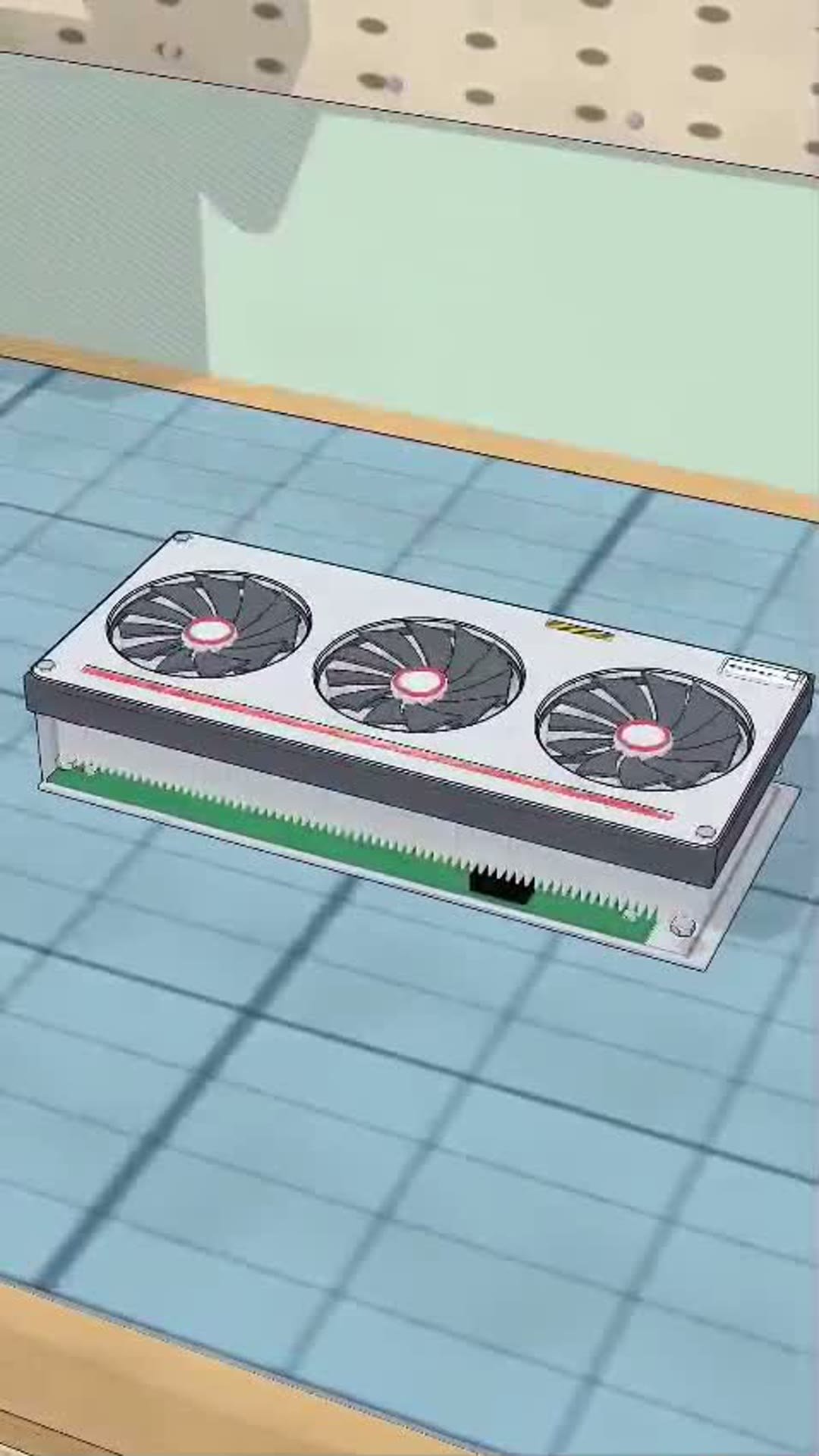
A graphics card has a few hundred parts. A tank has thousands. A passenger plane has millions. On paper, the card should be the easy one to copy. Take it apart, study it, build another one. The video explains why that plan falls apart at the very first step.
Four screws and the cooler comes off. Underneath sits one small square of silicon: the AD102 die, the chip at the heart of NVIDIA’s flagship RTX 4090. It measures about 608 square millimetres and packs in 76.3 billion transistors. So put it under a microscope and draw the blueprint. Not even close.
The chip is a city
The chip is not flat. It is a three-dimensional city, with more than ten layers of copper wiring stacked on top of each other, and wires only tens of nanometres wide. To see them, you have to peel the chip apart one layer at a time — and what you end up with is photographs. A map of lines. Not a blueprint.
The real blueprint is code, plus the software that turned that code into this layout. Photographing a chip, the video says, is like tasting a cooked dish and trying to write the recipe. And if you copy one wire wrong, you have just built a very expensive brick.
The machine that prints chips
Say you pull it off anyway. Now you have to print it. Only one kind of machine can print chips this small: an EUV lithography machine. It is the size of a bus, weighs about 180 tons and has more than 100,000 parts.
Inside it, a drop of molten tin is fired 50,000 times a second and hit with two laser pulses each time. That creates plasma at around 220,000 degrees, which gives off light of 13.5 nanometres. The mirrors that aim it are so smooth that if one were the size of Germany, its biggest bump would be less than a tenth of a millimetre. And exactly one company in the world builds this machine: ASML of the Netherlands.
The software wall
Even then, you are still not done. A chip with no software is just expensive sand. NVIDIA has been building its CUDA platform since 2006, and almost every AI tool in the world is built on top of it. It works like a railway gauge: nobody switches, because everything else was built to fit it.
So behind the thing you just unscrewed sits a design, a machine and an ecosystem. To copy a graphics card, you would first have to learn how to build your own EUV machine. Good luck.
Sources: NVIDIA; ASML.