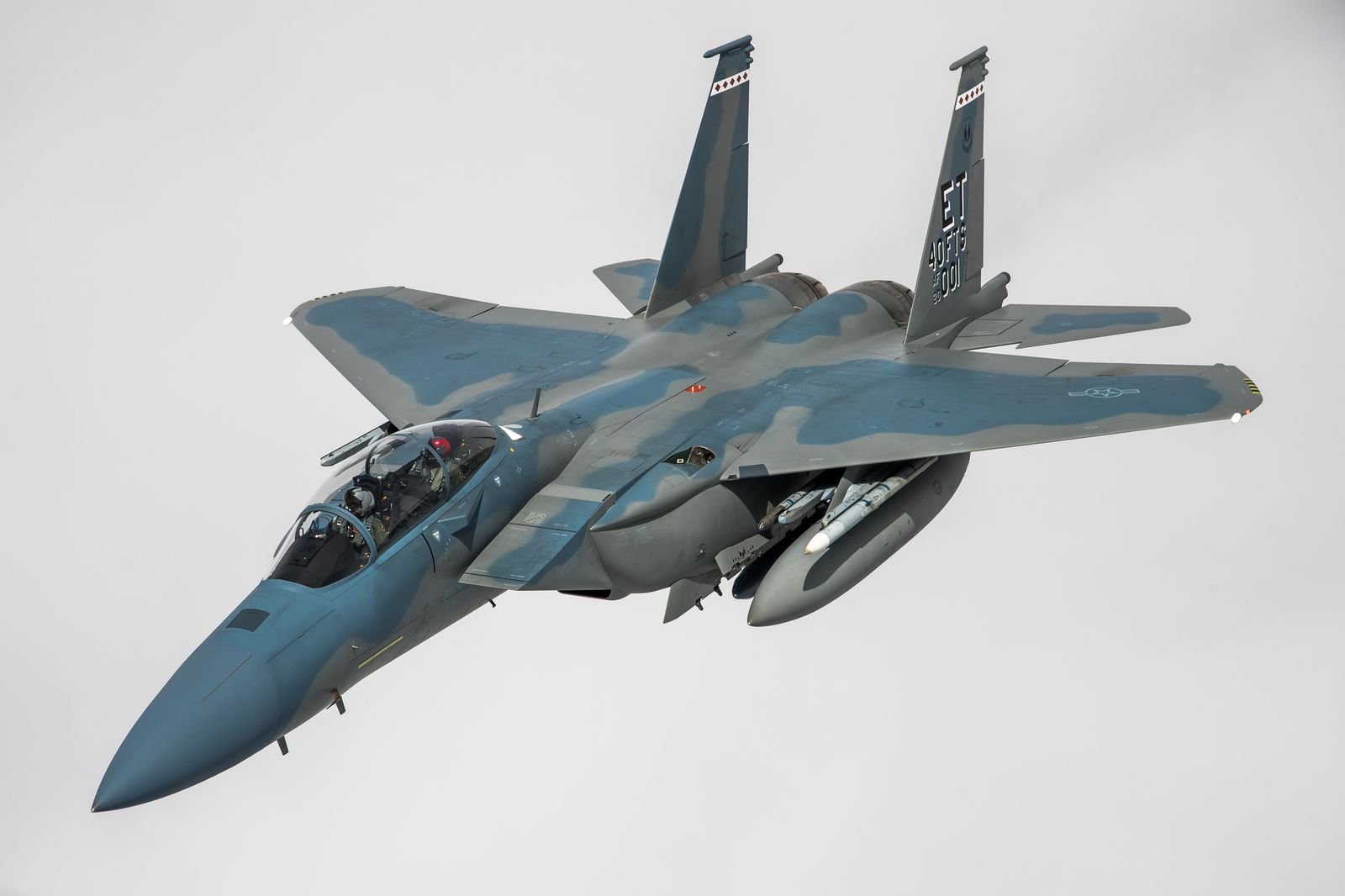
The first permanently stationed F-15EX Eagle II fighters have arrived at Kadena Air Base in Japan, putting the U.S. Air Force’s newest fighter on the front line of Pacific air defense for the first time.
The first two jets, assigned to the 67th Fighter Squadron of the 18th Wing, landed at Kadena on Sunday, November 15. The base, on the island of Okinawa, is now the first overseas Air Force installation to receive combat-coded F-15EX aircraft — jets assigned to a front-line combat unit rather than to testing or training — and only the second Air Force location to field the fighter at all, after the Oregon Air National Guard’s 142nd Wing at Portland.
“Getting the F-15EX to Kadena is just the beginning,” said Lt. Col. Ajay Dua, commander of the 67th Fighter Squadron.
A long-planned replacement
The arrival is the next step in replacing Kadena’s older F-15C/D fleet, which began a phased withdrawal in November 2022 after more than four decades of service. The Pentagon announced in July 2024 that it would station 36 F-15EXs at Kadena to replace the 48 F-15C/D Eagles flown by the 44th and 67th Fighter Squadrons. Both squadrons will operate the new jet.
Operators from the 67th Fighter Squadron traveled to Eglin Air Force Base in Florida and Portland Air National Guard Base in Oregon to maintain flying proficiency and complete aircraft qualification training in preparation for the arrival.
The first Kadena-bound jet, serial 22-0022, left Boeing’s St. Louis plant on August 28 wearing the 18th Wing’s “ZZ” tail code and flew to Portland before heading to Japan. The first two jets departed Honolulu for Kadena on November 14.
About a year late
The new jets arrived about a year later than first planned. Officials initially targeted spring 2026, but a strike at Boeing’s St. Louis plant from August to November 2025 disrupted deliveries.
Air Force Secretary Troy Meink told the Senate Armed Services Committee in May that the full transition would wrap up by 2028 or 2029. Fourth- and fifth-generation fighters will maintain a rotational presence at Kadena throughout the transition, so the arrival of the first two jets does not mean the end of the supporting deployments that have covered the base since the older Eagles began leaving.
| Kadena’s fighter transition | |
|---|---|
| Old fleet | 48 F-15C/D Eagles |
| New fleet | 36 F-15EX Eagle II jets |
| Squadrons | 44th and 67th Fighter Squadrons |
| First permanent arrival | November 15, 2026 |
| Full fleet in place | 2028 or 2029 |
What the jet brings
The F-15EX is the most advanced version of a fighter design that has been flying for half a century. It carries the APG-82 active electronically scanned array radar and the Eagle Passive Active Warning Survivability System, known as EPAWSS, and it can carry 12 air-to-air missiles — four more than earlier Eagles, thanks to four additional missile stations.
That loadout matters in the Pacific, where the distances are vast and the number of missiles a fighter can carry before it has to return and rearm shapes how long it can stay in a fight. Kadena sits at the center of that geography, closer to Taiwan and the East China Sea than any other major U.S. fighter base in the region.
What to watch next
The 67th Fighter Squadron’s immediate task is to integrate the aircraft into local flying operations and build experience with it. The wing has not given a date for when the full 36-jet fleet will be in place, and the two jets that arrived on Sunday are only the start of a delivery schedule that will run for years.
The arrival also lands in a wider debate about the U.S. military footprint in the Pacific, where the Air Force is spreading its fighters across more bases and hardening the ones it already has. Kadena’s new jets are the most visible sign yet of that shift — an older fleet finally giving way to the aircraft meant to replace it.
Sources: U.S. Air Force 18th Wing; The Aviationist; Defence Blog; Army Recognition.