










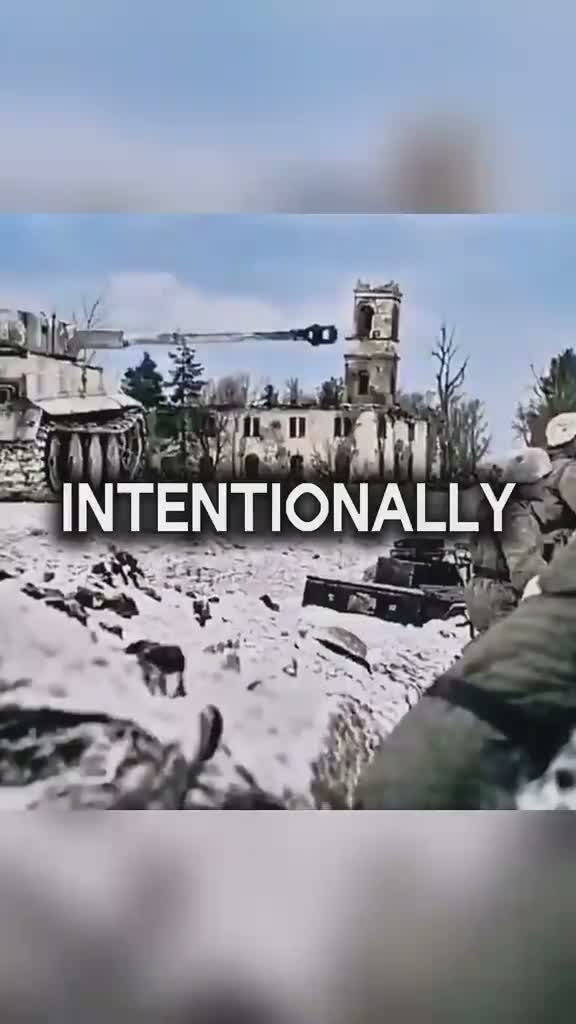
Why would a tank gunner aim to miss? In a short explainer now being shared widely, the answer is a piece of Second World War gunnery that sounds like a mistake — and was actually the plan.
The German Tiger I’s famous 88mm gun could hit targets thousands of metres away. But at those ranges, guessing the exact distance was the hard part. A small error in the range estimate could send a shell flying clean over the enemy tank — and a round that flies over tells the gunner nothing about where it went.
Aim short, watch the dust, correct
So, the video explains, Tiger gunners used a deliberate trick: they aimed short. The first shell was meant to hit the ground in front of the target and kick up a plume of dust. That dust showed exactly where the round had landed, and the gunner corrected his aim from there. According to the video, the Tiger’s crew manual — the Tigerfibel — even recommended setting the sight 100 metres below the estimated range. By the third shot, a hit was expected.
At long distances, in other words, the first miss was not a failure. It was part of the aiming process.
The method behind the trick
The underlying method is real and was standard practice, not a German invention. Tank gunners of the Second World War corrected their fire by “bracketing”: fire a round, observe whether it falls short or long, then split the difference until the rounds are on target. The U.S. Army’s own 1943 tank gunnery manual put it plainly — at ranges over 1,000 yards, bracket the target, because an “over” and a “short” give you a bracket to work from.
There was a practical reason to start short rather than long. A round that falls short throws up dust and earth in front of the target, where the gunner can see it. A round that flies over the target disappears behind it, and the gunner learns nothing. Older gunnery teaching made the same point for machine guns: fire the first shots short, because shorts are much easier to locate than overs.
The Tigerfibel itself — the illustrated crew manual issued to Tiger crews — devoted pages to range estimation, including measuring a target against the triangles in the gun sight and having the commander, driver and gunner each estimate the range and average the three figures. Judging distance by eye was never precise, which is why the correction process mattered so much.
The video’s specific claim — that the manual told crews to set the sight 100 metres below the estimated range — is presented in the clip itself; what the history supports is the method it describes. At the ranges the 88mm gun was built for, a miss that you could see was worth far more than a miss you could not.
Sources: the clip itself (narration as heard in the video); U.S. War Department, FM 17-12 Armored Force Field Manual: Tank Gunnery (April 22, 1943), on bracketing; Tigerfibel notes on range estimation and gun-sight use.
One thought on “Why Tiger Tank Gunners Deliberately Missed Their First Shot”