





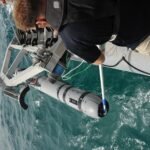

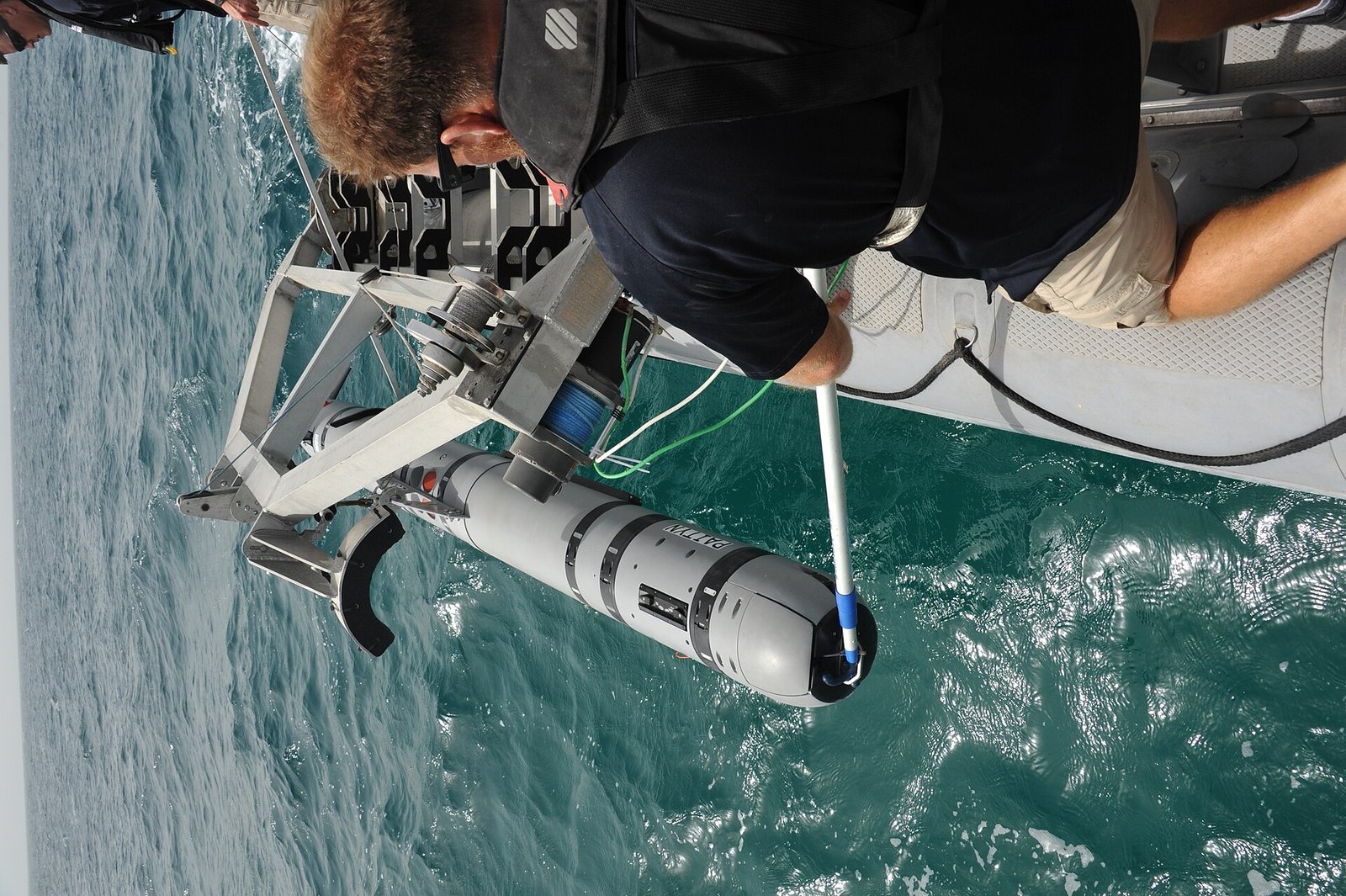
It looks like a small submarine, but there is no crew, no periscope manned by a sailor, and no one aboard to put at risk. Ghost Shark — the large uncrewed underwater vehicle developed by Anduril for Australia — is designed to do something crewed submarines cannot do cheaply: surface quietly, deploy equipment or launch drones, and slip back under the water.
A submarine that works alone
Ghost Shark is an extra-large autonomous underwater vehicle (XLUUV), built around a simple idea: many underwater missions do not need people at all. Surveillance, mine deployment, sensor placement and communications relay can all be handled by an autonomous hull that navigates by itself, stays submerged for long periods, and only surfaces when it has something to do.
The footage shows the core trick. The vehicle rises to the surface — in the naval-mine clip, its upper section opens to deploy mines — then submerges again. Nothing about that sequence needs a human hand on a control. Operators set the mission; the vehicle executes it.
Why navies want uncrewed hulls
The appeal is threefold. First, risk: an uncrewed vehicle can enter contested or mined waters where sending a crewed submarine would be reckless. Second, endurance and cost: without life support, berths and food, a robotic hull can stay out longer and cost far less per hull than a crewed boat. Third, numbers: a navy can field several uncrewed vehicles for the price of one traditional submarine, spreading sensors and weapons across a much wider area.
Australia’s program, developed with Anduril, is part of a wider race. The United States, Britain and China are all building large uncrewed underwater vehicles, and the Black Sea war has shown how quickly uncrewed systems — on the surface and under it — can change naval warfare.
The limits no one should ignore
Ghost Shark is not a replacement for a submarine. It cannot make judgment calls a captain makes, it depends on navigation and communications that can be jammed or spoofed, and its weapons and payload options are far narrower than a crewed boat’s. The honest picture is a division of labor: crewed submarines for the hardest, most complex missions, and uncrewed hulls like Ghost Shark for the dull, dirty and dangerous ones — surfacing, delivering, and vanishing before anyone realizes they were there.
Sources: Anduril and Royal Australian Navy public program descriptions of Ghost Shark; U.S. Navy public fact files on unmanned underwater vehicles.