










APFSDS: The Metal Dart That Punches Through Tank Armor Without Explosives
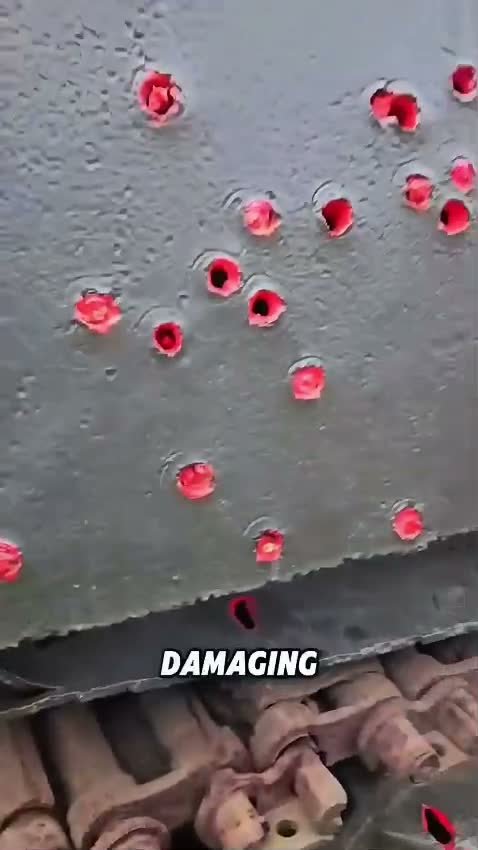
There is no explosive inside the most powerful tank round in service. No warhead, no blast — just a thin metal dart, heavier than steel, fired so fast that it punches through armour the way a needle goes through cloth. It is called APFSDS, and it is how modern tanks kill each other.
What the Letters Mean
APFSDS stands for Armour-Piercing Fin-Stabilised Discarding Sabot. Each word describes part of the trick. Armour-piercing: its job is to defeat vehicle armour. Fin-stabilised: small fins at the back keep it flying straight, like the fletching on an arrow. Discarding sabot: the dart rides inside a lightweight carrier — a sabot, from the French word for a wooden shoe — that seals the gun barrel and takes the force of the propellant, then peels away within about 100 metres of the muzzle, leaving only the dart in flight.
The Dart Itself
The penetrator is a long, thin rod, typically 2 to 3 centimetres across and up to about 80 centimetres long, made of tungsten alloy or depleted uranium. Both materials are more than twice as dense as steel. Depleted uranium has an extra advantage: as it pushes through armour it sheds material at the tip in a way that keeps the point sharp — a “self-sharpening” effect — while tungsten tends to mushroom. Depleted uranium is also pyrophoric, so the hot fragments ignite on contact with air inside the target, setting fire to fuel and ammunition.
Speed Is the Weapon
An APFSDS round leaves the muzzle at roughly 1,500 to 1,750 metres per second — over Mach 5 — and at a target two kilometres away it is still travelling at about 1,500 metres per second, arriving roughly one second after firing. Modern rounds penetrate 600 to 800 millimetres of rolled homogeneous armour steel at that range; the American M829A4 is rated at around 750 millimetres. All of that energy is concentrated on a point a few centimetres wide. At impact speeds like these, both the rod and the armour behave almost like fluids, and the rod wears itself away as it pushes through — the deeper it goes, the more of itself it spends.
Why Smoothbore Guns
Long rods cannot be stabilised by spinning, the way a rifle bullet is. Rifling would also waste energy, converting some of the propellant’s push into rotation instead of speed, and a fast-spinning finned dart would suffer extra drag. So APFSDS rounds are fired from smoothbore guns, which is why Western and Eastern tank guns alike moved to smooth bores. The fins do the stabilising instead, keeping the rod perfectly straight so it strikes the armour square-on.
What Happens Inside
Penetration is only half the story. Once the rod breaks through, spall — fragments blasted off the inside of the armour — and pieces of the rod itself tear through the crew compartment, destroying the crew, the ammunition and the electronics. There is no explosive in the round at all. The damage comes entirely from length, weight and speed.
The Other Way to Kill a Tank
APFSDS is a kinetic-energy round, and it is not the only approach. HEAT rounds use a shaped explosive charge and the Munroe effect: a metal cone, usually copper, collapses into a hypersonic jet of solid metal moving at up to 10 kilometres per second. Armour fights back against both: explosive reactive armour tiles detonate outward to snap a long rod or disrupt a HEAT jet, and composite armour layers ceramic, steel and elastic materials to blunt the impact. The duel between the dart and the armour has driven tank design for half a century — and the dart is still winning.
Sources: Wikipedia, Envanter Medya, Vectree.



One thought on “APFSDS: The Metal Dart That Punches Through Tank Armor Without Explosives”