








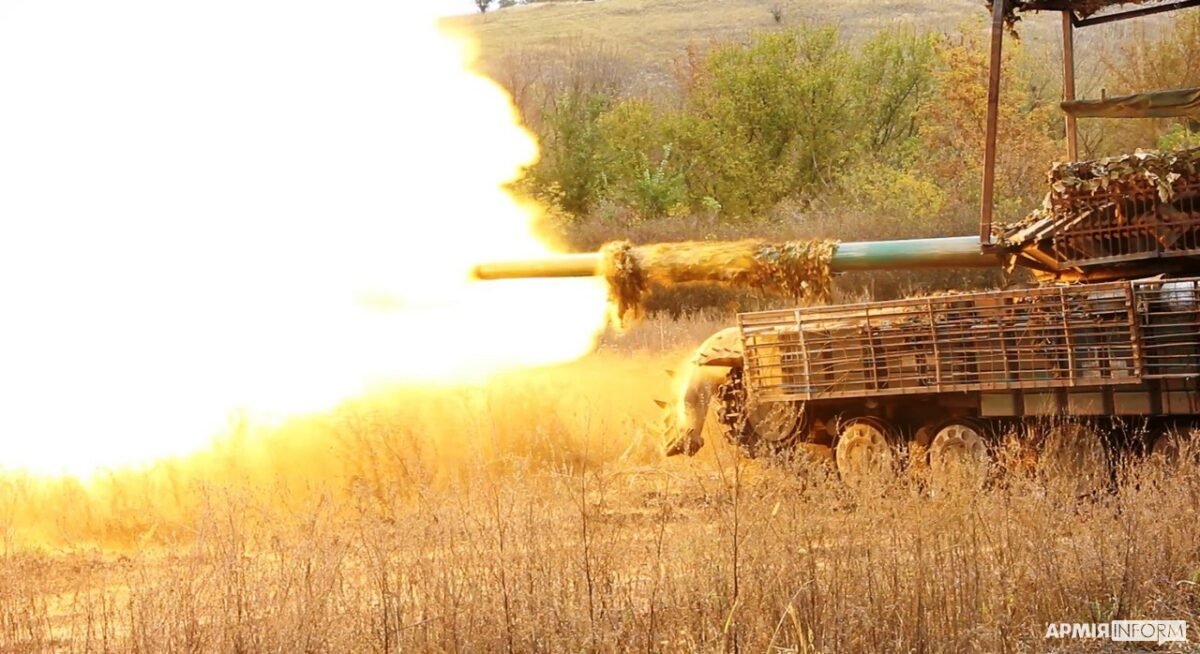
A tank rolling toward the front line in Ukraine today can be hard to recognize. A heavy mine-clearing roller hangs off the front. Steel mesh cages — quickly nicknamed “cope cages” — tower over the turret. Extra plates cover almost every surface. It looks like armor gone too far, and in one sense it is: these vehicles are carrying protection their designers never imagined. But every layer exists because of a specific threat, and every layer costs the crew something.
The mine roller: a battering ram that takes the blast
The roller at the front is not armor at all — it is a sacrifice. Mine rollers are heavy steel wheels pushed ahead of the tank, weighted to trigger anti-tank mines before the tank’s own tracks reach them. The blast destroys the roller section instead of the vehicle. Modern versions, like the ones Western armies fit to assault breacher vehicles, are built in segments so a damaged section can be swapped in the field.
The cage: built for a threat that falls from the sky
The cage over the turret answers a newer problem. Top-attack munitions and, above all, cheap FPV drones strike the roof — historically the thinnest armor on any tank. A spaced steel frame can detonate a drone’s warhead early or tangle its approach. What began as a mocked improvisation in 2022 is now factory-fitted on new vehicles from several countries, and navies of engineers are designing proper versions: lighter, hinged, and shaped so the crew can still escape quickly.
The trade-off nobody can engineer away
Here is the catch the footage raises: protection that blocks the turret’s rotation, slows the machine gun, traps the crew or adds tons of weight can get people killed in a different way. Armor design has always been a triangle of protection, mobility and firepower — improve one corner and the others suffer. The art is not maximum armor. It is the right armor for the threat in front of you, fitted so the crew can still fight the vehicle.
That is why the “too much armor” debate misses the point. Crews add these kits because the alternative — a bare roof under a drone-filled sky — is worse. The real question is whether factories can build the protection in properly, instead of soldiers welding it on the night before an assault.
Sources: Ukrainian Armed Forces imagery of cage-equipped armor (via Wikimedia Commons); manufacturer and U.S. Army public descriptions of mine-roller systems; open-source analyses of anti-drone cage armor in the Ukraine war.