








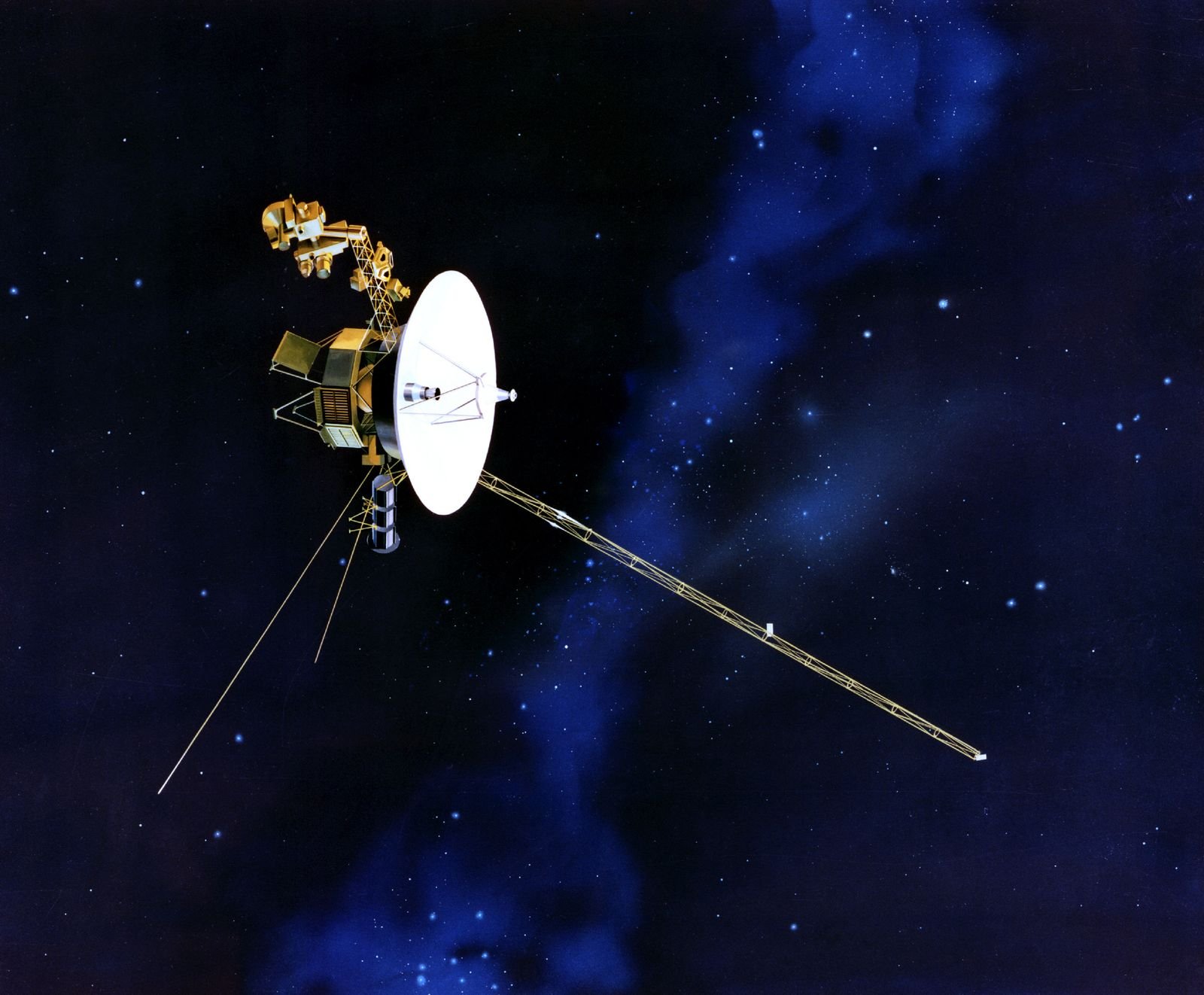
At 5:16:07 a.m. Eastern on Wednesday, November 18, 2026, NASA’s Voyager 1 spacecraft crossed a mile marker no human-made object has ever reached: one light-day from Earth.
A light-day is the distance light travels in 24 hours — about 16.1 billion miles, or 25.9 billion kilometers. For Voyager 1, reaching it has taken more than 49 years. Launched on September 5, 1977, from Cape Canaveral, Florida, the car-sized probe has been hurtling away from Earth at about 38,000 miles per hour ever since, and it is now so far away that a radio signal takes a full day to reach it — and another full day for its reply to come home.
A spacecraft that was never supposed to last this long
Voyager 1 was built for a five-year mission to fly past Jupiter and Saturn. It did that, and then it kept going. In December 2004 it crossed the termination shock, where the solar wind slows abruptly. On August 25, 2012, at about 11.3 billion miles from the Sun, it crossed the heliopause and became the first human-made object to enter interstellar space.
It has held the record as the most distant human-made object since February 1998, when it passed Pioneer 10. Its twin, Voyager 2, is about 13.4 billion miles away and is not expected to reach the one-light-day mark until about November 2035.
Both spacecraft carry a gold-plated copper disc — the Golden Record — engraved with sounds and images representing life and culture on Earth, in case anyone ever finds them.
Still talking, a day at a time
Voyager 1 is still sending data home, though there is less and less of it to send. As of April 2026, only two of its science instruments were still active: its magnetometer and its plasma wave subsystem. NASA hopes the probe will keep communicating into the early 2030s, before its power supply finally drops below the minimum needed to run anything at all.
The mission has had close calls. In October 2026, NASA reported that Voyager 1’s signal had gone missing during two scheduled communication sessions on October 18 and 19, after a set of thrusters went offline and backups switched on. Contact was restored on October 20 and has been maintained since.
“When I was first working on Voyager back in 1977, I never expected Voyager 1 to reach one light-day,” planetary scientist Linda Spilker of NASA’s Jet Propulsion Laboratory told ScienceAlert.
What to watch next
NASA invited people around the world to shine a light into the sky after sunset on Tuesday, November 17, to mark the moment. On Thursday, November 19, NASA officials will host a public discussion at the Jet Propulsion Laboratory in Southern California about the status of Voyager 1 and 2.
The light-day crossing is permanent. Because Earth orbits the Sun, its distance from Voyager 1 fluctuates through the year, but the spacecraft is travelling outward so relentlessly that even when Earth starts to move back toward it, Voyager 1 will remain more than a light-day away. It is, quite literally, a day away from home — and it will never come back.
Sources: NASA / Jet Propulsion Laboratory, November 17-18, 2026; ScienceAlert, November 17-18, 2026; USA Today, November 17, 2026.