






Why the Waterline Is a Trap
An amphibious landing looks like a fight on sand, but the first enemy is the sea itself. A shallow foxhole dug at the waterline may look ready in the morning, yet the next tide can fill it, soften its walls and wash sand back in as fast as a soldier can dig it out. The defender is then wet, exposed and busy bailing rather than watching the horizon. Spray and shifting sand also degrade the position without a shot being fired. A beach defense that lives in the surf is therefore already losing to the tide before the first boat arrives.
Build Back, in Concrete and Dunes
The Atlantic Wall, built by Nazi Germany between 1942 and 1944 along the coasts of continental Europe and Scandinavia, shows the opposite approach. Its builders used reinforced concrete pillboxes and bunkers on the beaches or slightly inland, often set into dunes and higher ground. Concrete gave overhead protection that sandbags and timber could not, while a dune gave height, a clearer field of fire and a natural rampart that was hard to climb under fire. A position built into the ground also presented a low profile to ships offshore, rather than a conspicuous line of men at the water’s edge.
Turn the Firing Slits Sideways
A bunker is only useful if its guns can fire without inviting destruction in return. That is why many coastal positions did not point their firing slits straight out to sea. An opening turned sideways, firing along the beach rather than directly at the approaching fleet, was far harder for naval guns offshore to hit head-on. A shell that might have flown straight through a seaward-facing embrasure instead struck concrete or earth at an angle. The trade-off was a narrower arc, but that arc covered exactly where landing troops had to move: across open sand and toward the dunes.
Stop Tanks With Steel Hedgehogs
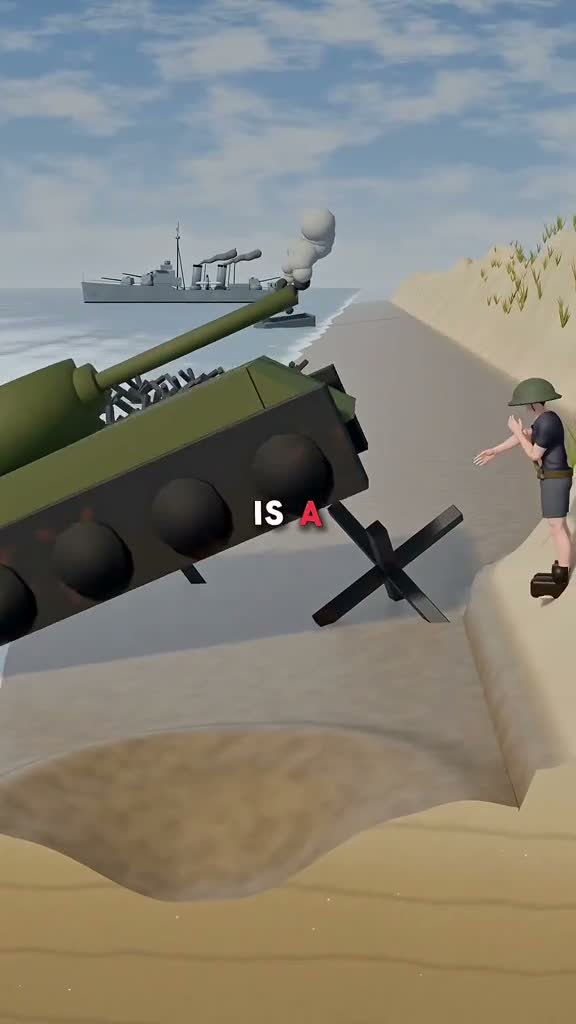
Before attackers could reach those bunkers, they had to cross a field of steel. The Czech hedgehog is a static anti-tank obstacle made from metal angle beams or I-beams joined into a three-armed cross, and examples were deployed on the Atlantic Wall. Its shape is the point: a tank cannot simply drive over it, and it still works even if tipped over by a nearby explosion, because another arm is always presented to the vehicle. Scattered across the sand, hedgehogs slowed armor, forced vehicles into narrow gaps and left them exposed to guns in the dunes, turning a fast breakout into a slow, channelled crawl.
Make the Surf Itself Dangerous
The water itself was also weaponized. Wooden poles and other beach obstacles were planted in the surf and on the sand, and mines were placed atop beach obstacles to strike landing craft before they could unload. At low tide the poles were visible and could be avoided or attacked; at high tide they were hidden beneath the surface, waiting for a hull to meet them. The same idea appeared inland, where slanted poles called Rommel’s asparagus were planted in likely landing places for gliders and parachutists. Every delay in the surf gave the defenders more time to fire.
Move Underground, Out of Sight
Behind the guns, survival depended on movement the enemy could not see. Tunnels under the dunes let defenders move men, ammunition and supplies between positions without crossing open sand under fire, and gave shelter during bombardment. The heavily fortified Channel Islands included tunnel systems known as Hohlgangsanlage tunnels, a reminder that a beach defense was not a single wall but a network. A bunker cut off above ground could still be resupplied or reinforced below it, and an attacker who captured one position did not automatically control the ground behind it.
| Defensive element | What it stops |
|---|---|
| Foxhole at the waterline | Fails — floods and silts in |
| Dune bunker | Naval shelling |
| Czech hedgehog | Tanks |
| Mined pole | Landing craft |
Sources: Wikipedia, “Atlantic Wall”; Wikipedia, “Czech hedgehog”; Imperial War Museums, Collection item A 23992, “Operation Overlord (The Normandy Landings): D-Day 6 June 1944”.