








A Name Born in the Cold
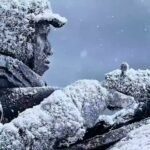
The phrase “Ice Sculpture Company,” in Chinese 冰雕连, does not describe a work of art. It is a commemorative name for a company of Chinese People’s Volunteer Army soldiers who, according to Chinese accounts, froze to death while still holding their positions around Lake Changjin, known in the West as the Chosin Reservoir, in the winter of 1950. The image is stark: men who did not retreat and did not survive the night, found later with weapons still in their hands. Every detail cannot be proved from battlefield records, but the name endures because it captures how cold, hunger, exhaustion, and duty combined in a punishing campaign.
The Battle Around the Reservoir
The Battle of Chosin Reservoir, also called the Battle of Lake Changjin, took place from 27 November to 13 December 1950 in the mountains of northeastern Korea. About 30,000 United Nations troops, principally the U.S. 1st Marine Division and elements of the U.S. Army’s X Corps, were surrounded by a much larger Chinese force, usually estimated at about 120,000 men of the People’s Volunteer Army 9th Corps. Surprised, the U.N. troops faced steep, road-bound terrain, and their only way out was a fighting withdrawal south to Hungnam.
Why the Cold Was So Deadly
A Siberian cold front descended on the reservoir area in mid-November 1950, and temperatures were estimated to fall as low as minus 36 degrees Fahrenheit, about minus 38 degrees Celsius. Weapons jammed as lubricants thickened, medical supplies froze, vehicles struggled on icy roads, and frostbite became a mass casualty in its own right. The U.S. 1st Marine Division alone reported more than 7,300 non-battle casualties from the cold. For the Chinese 9th Corps, rushed into Korea without winter clothing or adequate food and ammunition, exposure was even more devastating. More Chinese troops died from cold than from combat and air attack combined, and the 9th Corps was out of action for months afterward.
What Happened on the Ridge
Chinese commemorative accounts commonly associate the “Ice Sculpture Company” with the 20th Army’s 59th Division, in the area around Sasu-ri and Dead Eagle Ridge, where Chinese units were blocking the road between Yudam-ni and Hagaru-ri. In that telling, a company held a ridge through the night without fires that might have betrayed it and without clothing or shelter needed to survive. When daylight came, the men were dead where they had stood or lain, rifles still aimed toward the road. Treat the precise unit identification as commemorative tradition, not settled battlefield archaeology, because wartime records are incomplete. What is solidly documented is the context: Chinese troops in this sector were exposed, under-supplied, and dying in large numbers from cold.
The Salute: Tradition, Not Certain Record
According to the best-known version, U.S. Marines who found the frozen company saluted the dead men in recognition of their endurance. That salute is presented here as reported tradition, not as a verified fact from a contemporary American after-action report. The 2021 Chinese film The Battle at Lake Changjin dramatizes a similar moment, showing a retreating Marine column encountering frozen Chinese soldiers and its commander saluting them. A film scene is not evidence. The salute story matters as soldierly respect across a bitter war, but history must separate what was filmed, what was remembered, and what records prove.
Remembering Both Sides
The Chosin campaign left deep losses on both sides. United Nations forces broke out and were evacuated by sea from Hungnam, but at heavy cost in killed, wounded, missing, and frostbite cases. Chinese forces held the ground, but the 9th Corps suffered tens of thousands of casualties and was badly weakened. Remembering the “Ice Sculpture Company” should not celebrate suffering. It is a reminder that ordinary soldiers endured cold that no army had fully prepared for.
| Battle | Battle of Chosin Reservoir / Lake Changjin |
| Dates | 27 November – 13 December 1950 |
| Low temperature | About −38°C (−36°F) |
| Opposing forces | U.N. X Corps, mainly U.S. 1st Marine Division, against China’s PVA 9th Corps |
Sources: Wikipedia, “Battle of Chosin Reservoir” and “The Battle at Lake Changjin”; U.S. Marine Corps historical account “Frozen Chosin” by Edwin H. Simmons; U.S. Army official history by Roy Appleman, cited in the Chosin Reservoir article; Associated Press reporting on the “Ice Sculpture Company” (2022); and Chinese commemorative accounts of the 冰雕连.