







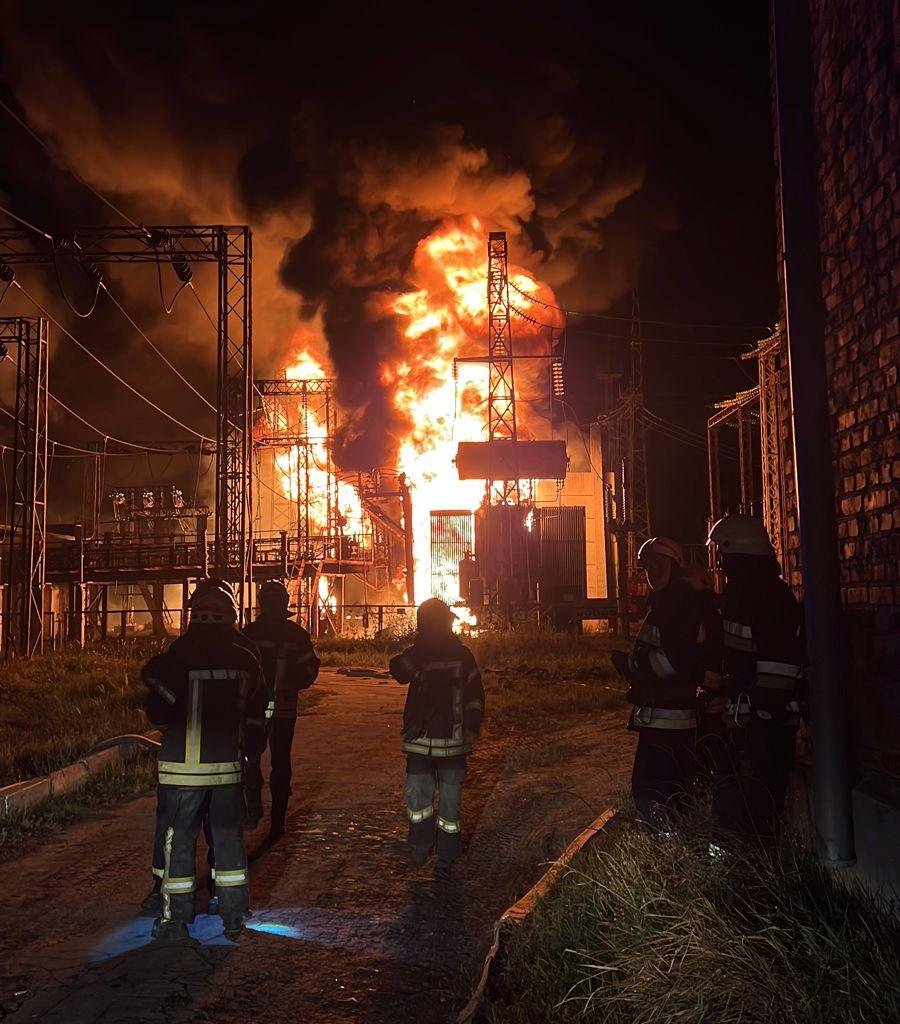
Russia launched a sweeping, multi-wave bombardment of Ukraine’s energy infrastructure on Tuesday, knocking out power to swathes of the country just a week before US-brokered peace talks are due to resume. President Volodymyr Zelenskiy said Russia fired 289 drones, 17 ballistic missiles and 59 cruise missiles, hitting power plants and substations from the Black Sea port of Odesa in the south to Rivne in the west.
A grid under strain as winter approaches
Ukraine’s largest private energy company, DTEK, said three of its five thermal power plants had been knocked offline. Officials said the damage forced power outages across the capital, Kyiv, and at least six other regions, and national grid operator Ukrenergo imposed emergency power cuts in some areas on Tuesday morning, including the Kyiv region.
Prime Minister Sergii Koretskyi said railways were also hit, damaging passenger carriages, locomotives and a train station. In Kharkiv, one of the hardest-hit cities, Mayor Ihor Terekhov said the attack damaged a medical facility and several neighbouring apartment buildings.
Russia’s Defence Ministry said its troops struck Ukrainian electricity facilities in several regions that supply power to military factories and the Ukrainian army. During more than four years of war, Russia has repeatedly targeted Ukraine’s energy system, destroying generation, distribution and heating facilities in attacks that have worsened each year as the cold winter months approach.
The other side of the night
Ukraine struck back at Russia’s oil infrastructure overnight. Russian officials said a Ukrainian drone attack set fire to a major oil refinery in the city of Yaroslavl, and the governor of Yaroslavl province said air defences had repelled an attack involving 124 drones targeting the refinery.
Russia’s Defence Ministry said air defences shot down 856 drones over Russian territory and the Black Sea overnight, with 493 detected in the Moscow region alone — one of the largest drone attacks on the capital region in the past six months, according to Moscow Mayor Sergey Sobyanin.
A shelter strike the day before
The barrage followed one of the deadliest strikes on civilians in recent months. On Monday, Russia dropped at least nine bombs on a school building in Komyshuvakha, in the Zaporizhzhia region, that was being used as a shelter and humanitarian aid distribution centre. At least 31 people were confirmed dead and another 48 were still unaccounted for, local governor Mykhailo Semikin said, and Zelenskiy described the strike as “utterly horrific.”
CNN reported the attack followed a familiar double-tap pattern: an initial wave of strikes, then a second strike as emergency services arrived. At least two first responders, Denys Konovalenko and Oleksiy Sushchevsky, both 44, were killed after rushing to the scene of the first strike.
Why the timing matters
Zelenskiy drew an explicit link between the timing of the barrage and the American political calendar. “It is very telling that all of this is happening on the day of the US congressional elections,” he said on Tuesday morning. “The Russians believe that America will not notice this signal from them. But such terror must be noticed and stopped.”
US President Donald Trump announced in September and October that both sides had agreed to halt attacks on energy targets, although neither side confirmed this, Reuters noted.
Talks confirmed for Abu Dhabi
Despite the escalation, diplomacy is moving. US envoy Steve Witkoff said on Monday that the United States will bring together delegations from Ukraine and Russia in Abu Dhabi on November 10–11 to discuss post-war security agreements, de-escalation, humanitarian measures and ending the war. The Kremlin confirmed the talks on Tuesday, with spokesman Dmitry Peskov saying Vladimir Medinsky, an aide to President Vladimir Putin, will serve as Moscow’s chief negotiator.
Witkoff and Jared Kushner, the lead US negotiators, are expected to represent the US, a senior US official told Reuters. American negotiators will also meet at working level this week in Brussels with representatives from France, Germany, Britain, the European Union and NATO. It will be the first US-mediated round since February, before the United States and Israel launched a war against Iran.
Separately, CNN reported that First Lady Melania Trump helped secure a ceasefire in the occupied Ukrainian city of Oleshky that enabled the evacuation of hundreds of civilians over the weekend, and that she will bring together representatives from Russia and Ukraine at the White House on Thursday.
What to watch next
Whether the Abu Dhabi talks survive the week’s escalation — and whether either side pauses strikes on energy infrastructure before winter sets in — will be the first test of whether this round of diplomacy is different from the last.
Sources: Reuters, “Russian strikes knock out power to swathes of Ukraine; Kyiv hits Russian refinery” (Nov 3, 2026); CNN, “At least 31 dead after Russia drops nine bombs on a Ukrainian school building” (Nov 3, 2026); Reuters via KWSN, “Kremlin confirms trilateral Ukraine peace talks in Abu Dhabi next week” (Nov 3, 2026); The Daily Star, “US to mediate trilateral talks with Ukraine, Russia in Abu Dhabi next week” (Nov 3, 2026).